Why some campaigns are forgotten before they even launch
Here’s a hard truth in B2B: many campaigns are doomed to fail – before they’re even launched.
We know. It sounds disheartening. But ask yourself how many B2B campaigns from the past year or so stick in your memory? Probably not a lot.

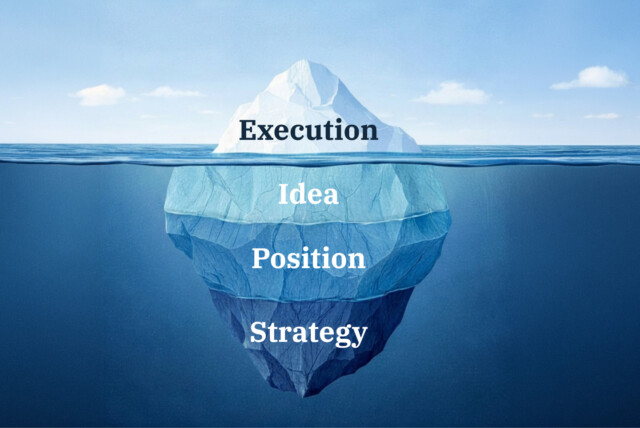
And no, weak or derivative creative is not always the reason why some campaigns land with a resounding thud. In fact, the fault usually rests further back in the campaign development stage – in vague strategy.
How to detect weak strategy – and how to fix it
There’s a surefire way to know if your campaign rests on weak strategy: show it to colleagues from across your company. But be careful not to show them logos or brand names, or to explain the campaign’s concept in advance. Instead, simply ask them: ‘Who does this feel like?’
If they fail to identify your company, that’s a red flag the underlying strategy isn’t sharp enough. And tinkering with the creative execution won’t fix matters – it’s back to the drawing board.
But it’s not all bad news. Because now you know what to focus on – formulating a crystal clear position; one that answers a single question: What is it we stand for that makes us truly special?
Strategy is what is remembered
The answer to the question is not what you make or offer. Neither is it what your product or service does. It’s your position – the area you occupy inside customers’ minds, and the associations they link with you.
Because here’s the thing: Markets remember clearly defined positions that are easily linked to specific brands. Great headlines and dazzling creativity of course play their role in communicating and reinforcing a position. But over time, even the best creative is forgotten by all but advertising professionals. However, a distinctive belief memorably expressed becomes shorthand for a B2B brand.
Think about B2B brands that have won memorability through razor sharp positioning:
- Salesforce didn’t just sell CRM – they built a category around ‘No Software’ and later positioned around ‘Customer 360.’
- Slack didn’t just say ‘messaging for teams – they hammered the idea of making work simpler and less chaotic.
- Zoom didn’t position itself as video conferencing software, but as the easiest way to meet, driven by a core message of ‘A meeting you don’t have to think about.’
These aren’t campaign ideas. They are crisply delineated positions that have shaped years of B2B communication.
The campaign stack: position, idea, execution
To build campaigns that last, B2B marketing teams need to separate three levels, and build upon them in sequence:
1) Position
This is the bedrock. It’s the one thing that makes you stand out, and that the market immediately associates with you. It’s your version of Zoom’s ‘A meeting you don’t have to think about.’
2) Campaign idea
The chapter you’re telling right now – the campaign that, whatever its tactical goal, also works strategically to solidify your position.
3) Execution
These are the campaign assets: videos, LinkedIn ads and posts, landing pages, event booths, PR, email sequences. Execution is where creativity lives – but it should always serve the idea, which in turn should always reinforce the position.
Many B2B campaigns fail because teams start at level three. They skip the essential positioning stage and jump into brainstorming assets.
Campaigns are stories with chapters, not one-offs
The best B2B marketing isn’t a string of disconnected campaigns and communications. It’s instead a cohesive narrative – a story built up of connected chapters that consistently supports the position over the long haul.
This approach informs the marketing behind the world’s most successful B2B brands. They don’t devise new messages every quarter. What they do is find new and fresh ways to consistently express the same position.
So instead of treating each campaign as a one-off special, see it as the next building block in a developing story, an episode that:
- Reinforces your strategic position
- Builds familiarity over time
- Adds depth rather than changes direction
That’s how you move from short-lived attention focused on a campaign to long-term B2B brand memorability. And such memorability is fundamental to success. Because when B2B buyers finally enter the market – when they’re ready to shortlist, compare, and choose – they don’t pick the brand with the most ads. They instead pick the brand they remember and trust: they opt for the brand that stands for something.
Want help building campaigns that actually stick?
If you want to be inspired, pressure-test your positioning, or would like to see some of the campaigns we’ve devised to build brand memorability, contact CBC’s Managing Partner, Ralph Krøyer, at rk@cbc.dk or on +45 35 25 01 60.


